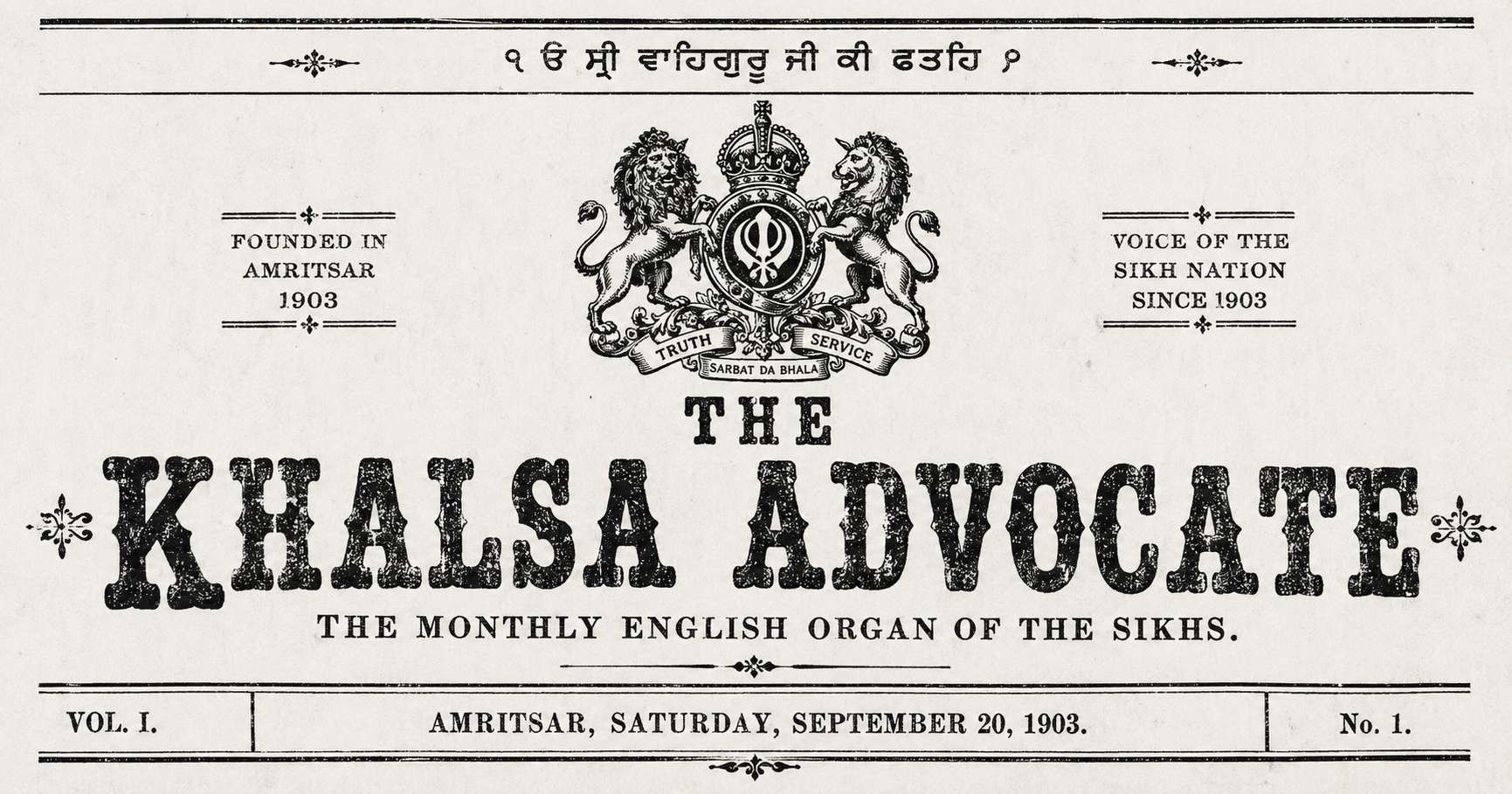
Reviving a name that once argued for reform, in the Sikhs' own English voice.
Independent Revival•Est. 1903 · Relaunched 2026
Reviving a name that once argued for reform, in the Sikhs' own English voice.
This site revives the name The Khalsa Advocate for a new, independent publication. It is not run by, endorsed by, or affiliated with the Chief Khalsa Diwan, which still exists today and has no connection to this project. The name is borrowed deliberately, out of respect for a paper that spent two decades arguing in print for reform — the account below covers that original run, 1903–1923, before any new material appears here.
By 1903, a growing readership of English-literate Sikhs in Punjab had no shortage of things to argue about — how gurdwaras should be run, what girls should be taught, whether old customs deserved to survive contact with a new century. The Khalsa Advocate was founded that September in Amritsar, under the Chief Khalsa Diwan, to give those arguments a printed home. It followed an earlier, shorter-lived attempt: Bhagat Lakshman Singh's paper The Khalsa, which had run for barely two years from 1899 before folding — proof enough that the appetite for an English-language Sikh paper existed, even if the first attempt hadn't lasted.
The paper began as a monthly and grew into a weekly, run out of Amritsar with a circulation that hovered around a thousand copies — modest by any measure, but enough to make it the leading English-language Sikh periodical of its era. It served, more or less officially, as the printed voice of the Chief Khalsa Diwan, covering the schools, colleges, and other institutions the Diwan operated, and giving space to contributors including the writer Vir Singh.
The paper's clearest political stance concerned who should run Sikh shrines. From the middle of the century's first decade it pressed for the Golden Temple and other gurdwaras to be freed of what it considered accumulated abuses, and argued the temple's manager should be chosen by the wider Sikh community rather than appointed by the colonial government. By 1917 it was printing direct complaints about mismanagement and corruption at the Golden Temple itself — a position that placed it firmly alongside the reform movement that would, within a few years, force the issue.
The paper also weighed in on how Sikh children should be taught, backing Punjabi as the language of instruction while insisting the choice of script belonged to parents, not administrators — a stance that treated language policy as a matter of family autonomy rather than official convenience.
Dowry, child marriage, domestic violence, polygamy, mismatched marriages, extravagant weddings, the practice of purdah, and prostitution, which it treated as a social ill rather than a private matter.
Remarriage for widows, a Sikh-elected (not government-appointed) manager for the Golden Temple, and parental choice over the script children were taught to read.
A newspaper's tagline is a small, dated thing — a sentence its editors were willing to stand behind that particular year. The Advocate carried several over two decades, and the sequence tracks the paper's own drift from a general-purpose Sikh journal toward an openly reformist one, before the title itself changed hands with the language.
Launched monthly as the printed organ of the Chief Khalsa Diwan, positioned as a general forum for Sikh opinion in English.
Coverage shifts toward gurdwara management as the paper begins openly campaigning for reform of the Golden Temple's administration.
The 9 June issue names corruption and mismanagement at the Golden Temple outright — no longer arguing principle, but reporting specifics.
The English-language run ends. The paper continues under the Chief Khalsa Diwan in Punjabi, under a new title, carrying the same mission to a different readership.